
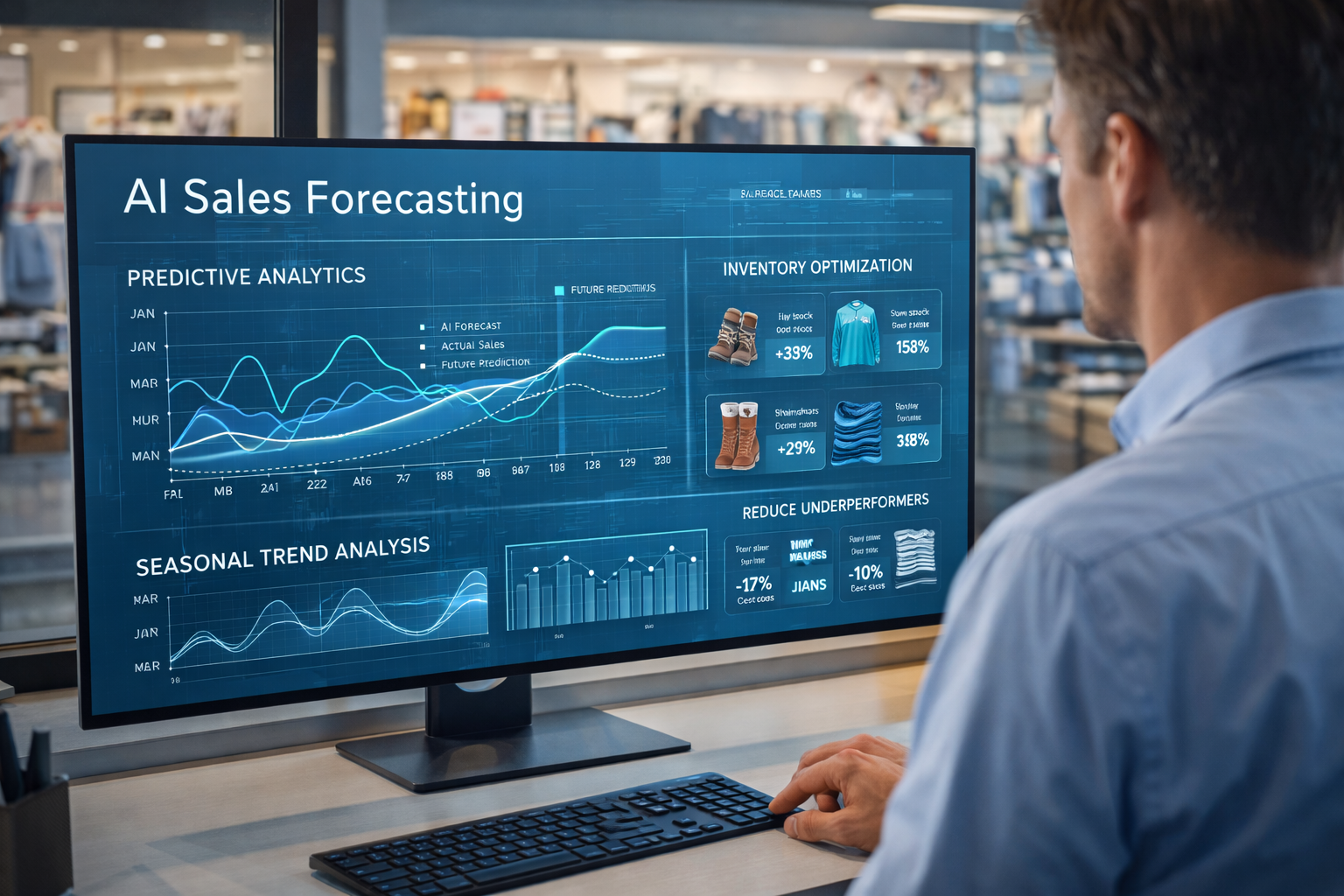
Beyond Spreadsheets: AI Sales Forecasting for Retail Success
Why Your Excel Forecast Is Wrong 40% of the Time—And What to Use Instead
You pull up your spreadsheet every Monday morning. Last year's numbers, a growth percentage, maybe a seasonal adjustment you eyeball. That's your forecast. And it's probably wrong by 30-50%. Not because you're bad at spreadsheets—because spreadsheets are bad at forecasting.
Machine learning achieves 85-88% forecasting accuracy compared to 50-64% for spreadsheet methods. That gap isn't a rounding error—it's the difference between thriving and surviving.
Why Spreadsheets Fail at Forecasting
I've used spreadsheets for 30 years. They're incredible tools for many things. Sales forecasting is not one of them. Here's why:
They're Backward-Looking
A spreadsheet forecast is essentially “last year + a percentage.” It can't account for the new competitor that opened two miles away, the demographic shift in your neighborhood, or the TikTok trend that's about to spike demand for a product you barely stock. Spreadsheets tell you where you've been. AI tells you where you're going.
They Can't Handle Complexity
Real retail demand depends on dozens of variables: weather, local events, competitor actions, economic indicators, social media trends, day of week, promotional calendars, and seasonal cycles. A human with a spreadsheet can maybe track 3-4 of these. AI processes all of them simultaneously and finds the hidden correlations.
They Don't Learn
When your spreadsheet forecast is wrong (and it will be), you manually adjust. But do you adjust the underlying model or just override the number? AI forecasting systems automatically learn from every prediction error, getting more accurate over time without manual intervention.
What AI Forecasting Actually Looks Like
Let me demystify this. You don't need a data science team. Modern AI forecasting for retail works like this:
Connect Your Data Sources
Your POS system, inventory records, and (optionally) weather and local event data. Most tools connect via API or simple CSV upload. One-time setup: 2-4 hours.
AI Builds Your Model
The system analyzes your historical sales, identifies patterns you didn't know existed, and builds a forecasting model specific to YOUR business. Not a generic retail model—one calibrated to your customers, location, and product mix.
Get Actionable Forecasts
Weekly or daily forecasts by product, category, or department. Not just “you'll sell X units” but confidence ranges: “70% chance you sell between 45-55 units, plan for 55 to avoid stockouts.”
Review and Override When Needed
You know things AI doesn't—the road closure next month, the church event that always drives traffic. Override the forecast when you have local intelligence. The AI incorporates your override into future predictions.
The Real-World Impact: Three Scenarios
Scenario 1: Seasonal Planning
A garden center using spreadsheets orders spring inventory based on last year's sales plus 10%. AI analyzes the last 3 years of data along with weather forecasts, housing starts in the area, and social media gardening trends. Result: 22% more accurate category-level forecasts, meaning less overstock on slow-moving shrubs and fewer stockouts on trending plants.
Impact: $35K better inventory allocation on a $400K seasonal buy.
Scenario 2: Fashion and Trend Sensitivity
A clothing boutique carries items with short trend cycles. Spreadsheet forecasting can't capture when a style is peaking versus fading. AI monitors sell-through velocity in real time and flags items that are accelerating (reorder now) versus decelerating (don't reorder, plan a promotion).
Impact: 40% reduction in end-of-season markdowns, 15% fewer missed sales from stockouts on trending items.
Scenario 3: Perishable Goods
A specialty food store with perishable products can't afford overstock—it goes in the trash. AI forecasting incorporates day-of-week patterns, weather impact on foot traffic, and upcoming events to predict daily demand for perishables within tight ranges.
Impact: 25% reduction in spoilage waste, which for a store throwing away $2,000/month in expired product, is $6,000/year straight to the bottom line.
The ROI Framework
Forecasting ROI Calculator
Step 1: Quantify your current forecast errors
- Overstock markdowns last year: $______
- Estimated lost sales from stockouts: $______
- Spoilage/waste from over-ordering: $______
- Hours spent on manual forecasting/week × $wage × 52: $______
- Total annual cost of poor forecasting: $______
Step 2: Apply conservative AI improvement
- Markdown reduction: 20-30%
- Stockout reduction: 15-25%
- Waste reduction: 20-30%
- Time savings: 70-80%
Step 3: Subtract AI tool costs
- Monthly subscription: $200-800
- Setup: $1,000-5,000 (one-time)
- Training: 8-16 hours of staff time
For most retailers doing $1M+ in revenue, the math works out to 3-8x return on the AI investment. The companies seeing 82% positive ROI from AI aren't guessing—they're measuring.
Getting Started: The Spreadsheet-to-AI Bridge
You don't have to abandon spreadsheets overnight. Here's the practical migration path:
Week 1: Benchmark Your Current Accuracy
Compare last month's spreadsheet forecast to actual sales by category. Calculate the error rate. This is your baseline. Most retailers are shocked to find they're off by 30-50% at the category level.
Week 2-3: Run a Parallel Test
Sign up for a free trial of an AI forecasting tool (Inventory Planner, Forecastly, or even upload your data to ChatGPT for a basic analysis). Generate AI forecasts alongside your spreadsheet forecasts. Don't act on them yet—just compare.
Week 4: Measure the Gap
After a month, compare which forecast was more accurate. If AI beat your spreadsheet (it almost always does), calculate the dollar value of that accuracy improvement. That's your projected annual savings.
The Competitive Reality
The AI-powered forecasting market is growing from $68 billion to $159 billion by 2031. That growth isn't happening because the technology doesn't work—it's happening because retailers who adopt it are outperforming those who don't.
Your competitors are making this move. The question is whether you'll be the one with better forecasts or the one wondering why their margins keep shrinking.
Your Forecasting Accuracy Challenge
This week, test your forecasting accuracy:
- 1. Pull last month's forecast vs. actual sales for your top 20 products
- 2. Calculate the average error percentage
- 3. Multiply that error by the dollar value (overstock + stockout cost)
- 4. Upload the same data to ChatGPT and ask for a forecast—compare accuracy
When you see the gap between your spreadsheet and what AI can do, the investment decision makes itself.
Want to explore what AI can do for your business?
Let's have a conversation about your specific operations and challenges.
Schedule a Free Discovery Call