
Is AI Worth It for Manufacturing?
Calculate Cost Reduction ROI Before You Spend a Dime
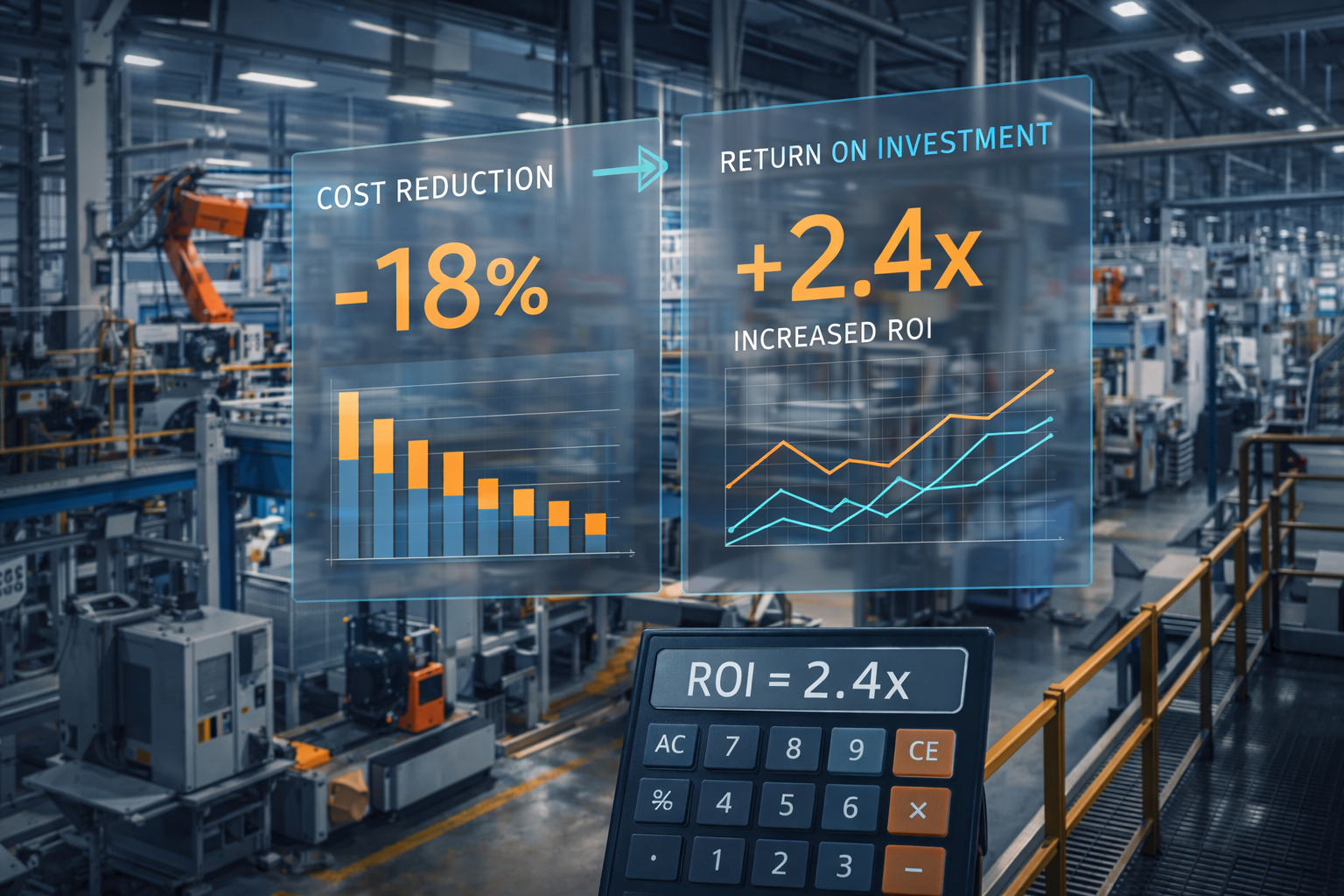
You run a manufacturing operation. Every dollar matters. Someone on your team just pitched an AI project, and your first question is the right one: “What's the return?” Here's how to calculate it—with real numbers, not vendor hype.
In 30 years of manufacturing operations, I've never seen a technology with this ratio of low cost to high impact. But you still need to do the math.
Why Manufacturers Are Skeptical (And Should Be)
Manufacturing isn't Silicon Valley. You can't afford to “move fast and break things” when “things” means a $200K CNC machine or a production line running three shifts. I've managed plants where a single hour of downtime cost $15,000. You don't experiment with that lightly.
But here's what I've learned: the manufacturers who calculate ROI first and implement second are the ones who succeed with AI. The ones who buy the shiny tool first? They end up with expensive shelf-ware.
The Manufacturing AI ROI Framework
Forget generic ROI calculators. Manufacturing has specific cost categories that AI targets. Walk through these four areas and you'll know exactly where AI pays off in your operation.
Area 1: Predictive Maintenance
This is the highest-ROI entry point for most manufacturers. Instead of scheduled maintenance (which over-maintains some equipment and under-maintains others), AI monitors actual equipment condition and predicts failures before they happen.
The math: If you spend $200K/year on maintenance and experience $80K in unplanned downtime, AI-driven predictive maintenance typically cuts maintenance costs 25-40% and reduces unplanned downtime by up to 40%. That's $50K-$80K in the first year for tools that cost $500-2,000/month.
Area 2: Quality Defect Reduction
I've seen plants where the scrap rate quietly climbed from 3% to 8% over two years because nobody was tracking the patterns. AI vision systems and statistical process control catch drift that human eyes miss—especially on second and third shifts.
The math: A 15-person shop running $2.5M in revenue with an 8% scrap rate is burning $200K/year. AI-assisted quality monitoring typically reduces scrap 30-50%. Even a conservative 30% improvement saves $60K annually.
Area 3: Energy Management
Energy is often the third-largest cost in manufacturing behind materials and labor. AI-driven energy management systems optimize HVAC, compressed air, and machine scheduling to reduce consumption without affecting production.
The math: Facilities spending $150K+/year on energy typically see 10-20% reduction through AI optimization. That's $15K-$30K/year from a system that runs in the background.
Area 4: Inventory and Supply Chain
Carrying too much raw material ties up cash. Running out stops production. AI demand forecasting analyzes your historical orders, lead times, and seasonal patterns to optimize ordering.
The math: If you carry $500K in raw materials and AI reduces carrying costs by 15-20%, that's $75K-$100K freed up in working capital—money you can invest in equipment, people, or growth.
The ROI Calculation Worksheet
Here's the exact framework I use. Grab a calculator and fill in your numbers:
List Your Top 5 Cost Categories
Maintenance, scrap/rework, energy, inventory carrying costs, and labor on repetitive tasks. Write down last year's spend for each.
Estimate Conservative Improvement
Don't use the vendor's best-case numbers. Use the low end: 15% maintenance reduction, 20% scrap reduction, 10% energy savings. These are realistic first-year targets.
Calculate Annual Savings
For a typical $5M revenue manufacturer, this often lands between $80K-$200K.
Subtract Implementation Costs
Be honest about the full cost:
- Software subscriptions: $500-$3,000/month
- Setup and integration: $5,000-$25,000 (one-time)
- Training time: 20-40 hours across your team
- Ongoing management: 2-5 hours/week
First-year total cost typically runs $15,000-$60,000 depending on scope.
Apply the Formula
Where to Start (The 90-Day Pilot)
Don't try to AI-enable your entire operation at once. Pick the highest-cost, most measurable area and run a focused pilot.
The Best First Project
For most manufacturers, predictive maintenance wins because:
- Measurable baseline: You know what you spend on maintenance today
- Clear metrics: Downtime hours, maintenance costs, parts replaced
- Low risk: You're adding monitoring, not changing the process
- Quick wins: Most facilities see first results in 30-60 days
Start with your most critical (and most expensive) piece of equipment. One machine. One sensor. One dashboard. Prove the value, then expand.
What About Small Manufacturers?
The question I hear most: “We're only 15 people. Is AI even for us?”
Actually, small manufacturers often see the best ROI because:
- Lower implementation costs: Fewer machines, simpler integration
- Faster decision cycles: No committee approvals—you decide, you implement
- Bigger relative impact: Saving $50K means more when revenue is $3M than $300M
- Available tools: Cloud-based AI tools start at $50-500/month—no enterprise contracts required
KPMG reports that 76% of manufacturers plan to adopt new technologies, and 34% already see ROI from multiple AI use cases. The early adopters aren't just Fortune 500 companies—they're shops with 10-50 employees who did the math and liked what they saw.
The Cost of Waiting
Here's the calculation most people skip: what does it cost to not implement AI? If your competitors reduce their costs 15-25% through AI-driven improvements, your margins shrink even if nothing in your operation changes.
In manufacturing, operational efficiency isn't optional—it's survival. The question isn't whether AI will affect your industry. It's whether you'll be the one using it or the one competing against it.
Your Manufacturing ROI Challenge
This week, run the numbers on one area of your operation:
- 1. Pick your highest maintenance-cost machine
- 2. Calculate last year's total cost (parts + labor + downtime)
- 3. Apply a conservative 20% reduction
- 4. Compare against $500-2,000/month for AI monitoring
If the math works on one machine, imagine what it looks like across your entire floor.
Want to explore what AI can do for your business?
Let's have a conversation about your specific operations and challenges.
Schedule a Free Discovery Call