
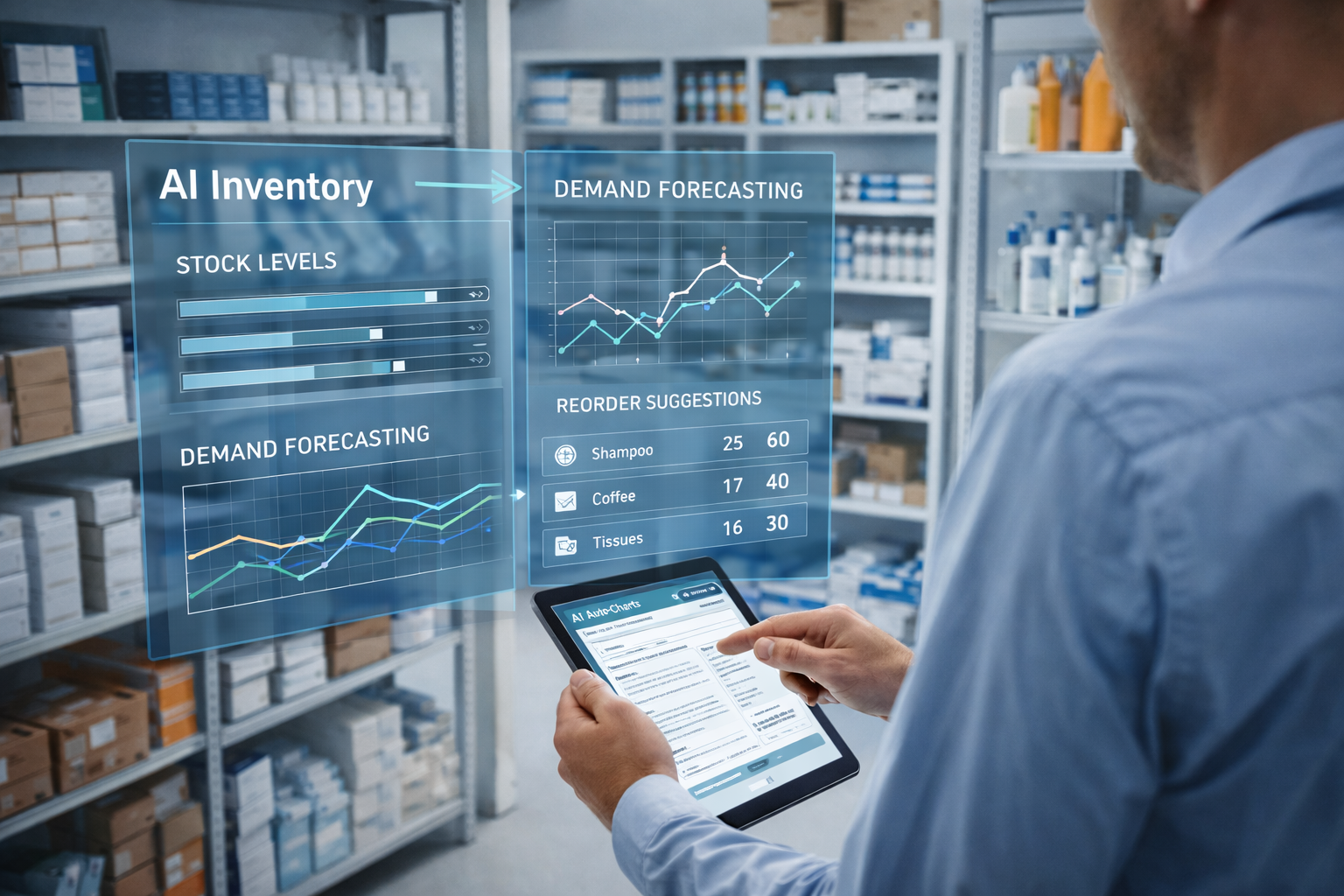
Retail Inventory Decisions: From Gut Feel to AI-Powered Smart Moves
Stop Guessing What to Stock—Let Data Drive Your Inventory Decisions
You walk through your store and something feels off. Too much of Product A sitting on shelves. Product B sold out again. You order based on what “feels right”—and most of the time it works. But “most of the time” isn't good enough when overstock ties up cash and stockouts send customers to your competitor.
Every empty shelf is a lost sale. Every overstocked shelf is trapped cash. AI doesn't replace your retail instincts—it gives them data to work with.
The Real Cost of “Gut Feel” Inventory
I've spent 30 years in operations, and I respect intuition. A good retail manager develops a feel for their inventory that takes years to build. But here's what I've also learned: intuition doesn't scale, and it can't process 500 SKUs across multiple seasons, promotions, and external factors simultaneously.
Consider what gut-feel ordering actually costs:
Overstock: The Silent Cash Killer
When you over-order, that money sits on your shelves instead of in your bank account. For a retailer carrying $200K in inventory, even 20% excess stock means $40K in trapped capital—money that could fund marketing, hiring, or expansion.
Add storage costs, potential markdowns, and spoilage (for perishable goods), and overstock easily costs 25-35% of the excess inventory's value per year.
Stockouts: The Customer You'll Never See Again
Research shows stockouts cost retailers over 4% of annual revenue. But the hidden cost is worse: a customer who can't find what they came for doesn't just leave empty-handed—they go to your competitor. And they might not come back.
For a $1M revenue retailer, that 4% is $40,000 in lost sales per year. How many of those customers came back? Probably fewer than you think.
The Reorder Guessing Game
How do you decide when to reorder? If the answer involves walking the floor and “eyeballing it,” you're spending management time on a task that AI handles in seconds—and AI doesn't miss the item hiding in the back corner of the stockroom.
What AI Actually Does for Inventory
Let's demystify this. AI inventory management isn't robots counting your shelves (though that exists too). For most small retailers, it means software that:
Analyzes Your Sales History
Not just “we sold 50 of these last month” but patterns across seasons, days of the week, weather, local events, and promotional periods. AI sees the patterns your spreadsheet doesn't.
Forecasts Future Demand
Using those patterns to predict what you'll sell next week, next month, and next quarter—with confidence ranges so you know how certain the prediction is.
Generates Smart Reorder Points
Instead of a fixed reorder point (dangerous with variable demand), AI calculates dynamic reorder points based on current trends, lead times, and desired service levels.
Flags Anomalies
Product suddenly selling faster than expected? New competitor opened nearby? Supplier lead time getting longer? AI catches these shifts before they become stockouts or overstock situations.
The ROI Math for Retail Inventory AI
Let's run the numbers for a typical small retailer:
Scenario: $1.5M Revenue Retailer, $300K Inventory
Current waste (conservative):
- Overstock markdowns: $18K/year (6% of inventory)
- Stockout lost sales: $60K/year (4% of revenue)
- Excess carrying costs: $15K/year
- Total annual cost of poor inventory management: $93K
With AI inventory management:
- Tool cost: $200-800/month ($2,400-$9,600/year)
- Setup and training: $2,000-5,000 (one-time)
- Conservative improvement: 30% reduction in waste
- Annual savings: $28K against $12K cost = 133% ROI
Getting Started Without Ripping Everything Out
You don't need to replace your POS system or hire a data scientist. Here's the practical path:
Level 1: Use What You Have
Export your sales data from your POS to a spreadsheet. Upload it to ChatGPT or Google Gemini and ask: “Analyze my sales trends by product category over the last 12 months. Identify seasonal patterns and flag products with high variability.” Free. Takes 10 minutes. You'll learn something.
Level 2: Add a Forecasting Tool
Tools like Inventory Planner, Stockly, or Brightpearl connect to your existing POS and generate demand forecasts automatically. Most offer free trials and start at $100-300/month for small retailers. The setup takes a day, not a month.
Level 3: Automated Reordering
Once you trust the forecasts, let the system generate purchase orders automatically. You review and approve—the AI does the math, you make the final call. This is where the real time savings kick in.
Your Gut Feel Isn't Going Away
I want to be clear: AI doesn't replace your retail knowledge. You know your customers. You know your neighborhood. You know that the construction project down the street will affect foot traffic for three months.
What AI does is handle the math—the 500 simultaneous calculations across SKUs, seasons, and trends that no human brain can process in real time. You bring the judgment. AI brings the data. Together, you make better decisions than either could alone.
Your Inventory Intelligence Challenge
This week, test AI on your own inventory data:
- 1. Export 12 months of sales data by SKU from your POS
- 2. Upload to ChatGPT and ask for demand patterns and anomalies
- 3. Compare AI's top 10 “overstock risk” items to your gut feel
- 4. Check which ones are actually sitting on your shelves right now
Bet you'll find at least 3 surprises. That's the gap between gut feel and data—and it's where the money is.
Want to explore what AI can do for your business?
Let's have a conversation about your specific operations and challenges.
Schedule a Free Discovery Call